Thứ Ba, 4 tháng 2, 2014


Centenary Celebration of First Felicitation of Rabindranath Tagore as Nobel Laureate


image


Special Cover on Centenary Celebration of First Felicitation of Rabindranath Tagore as Nobel Laureate - 1st February 2014.

As a part of Centenary Celebration of the First Felicitation of Rabindranath Tagore as Nobel Laureate organised by Rammohan Library and Free Reading Room, Kolkata a special cover was released in Kolkata on 1st February 2014. The cover is designed by Shri Babul Dey.

image

13 November 2013 marked the centenary of Rabindranath Tagore’s Nobel Prize in Literature. Almost 100 years back, the writer, educationist and philosopher was informed of being conferred with the prestigious award. Stating the reasons, the Swedish Academy said that “because of his profoundly sensitive, fresh and beautiful verse, by which, with consummate skill, he has made his poetic thought, expressed in his own English words, a part of the literature of the West”. Born on May 7, 1861, Tagore in 1913 became not just the first Asian Nobel laureate but the first non-European to win the Nobel Prize for literature.

Courtesy : Indian Philately Digest


New Love Stamp from Slovenia


image 

Date of Issue : 31 January 2014

Here is a beautiful stamp from Slovenia to send very special greetings to someone you love !!

Even though an old Slovenian proverb says that the way to someone’s heart is through their stomach, this relationship between two people is first and foremost a matter of the heart. This is also proven by a silver ring from the collection of the Slovenian Ethnographic Museum in Ljubljana formed by two hands holding a heart with a crown and featured on a new Slovenian stamp. The ring thus symbolizes the crown to a couple’s love, which can denote engagement, wedding or merely an objectification of love between two partners. In Slovenia this way of displaying love and affection between the two sexes goes back to the seventeenth century when wedding rings began to be used.

image image

Wearing rings for decoration and the custom of giving a ring to someone as a token of affection developed later on, in the second half of the nineteenth century. The Slovenian word prstan “ring” itself also developed later than some other similar expressions such as rinka, rincica and rincca, which are all derived from the German word Ring “ring, circle”.


Thứ Ba, 9 tháng 7, 2013


Tagore-Gandhi special cover 2013_L (1)

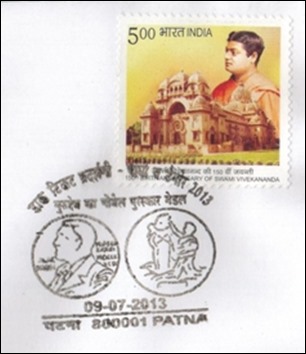
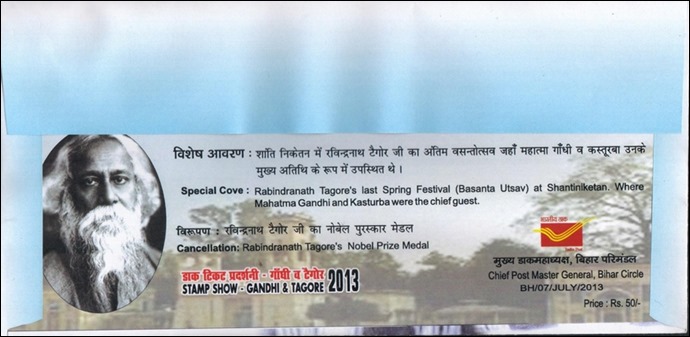
A special Cover was released on 9th July by Bihar Postal Circle in Patna during a stamp exhibition on Rabindranath Tagore and Mahatma Gandhi. The cancellation of the cover features Tagore’s Nobel Prize medal.Special Cover dipicts a photograph of Bapu, Baa & Tagore at Shantiniketan in Spring festival (Basanta Utsav) Kolkatta, and where Mahatma Gandhi and Kasturba were the Chief guests.

Tagore-Gandhi special cover 2013_L (1)

Tagore-Gandhi special cover 2013_L (1)

Stamp Show : Gandhi & Tagore : 9 July 2013 : Patna

The  covers are available at Philatelic Bureau Patna GPO @ 50/ per piece through Counter or Mail order. Kindly send Money Order to the Chief Postmaster Patna GPO Patna –800001. Ph. 0612 - 2236937

: Pradip Jain – Patna  email : philapradip@gmail.com

HI !

I am sharing here two articles published in “The Hindu” today…It is time to prepare to post last telegram before 15th July…On 15th, the  telegram services will be discontinued….
Untitled-6

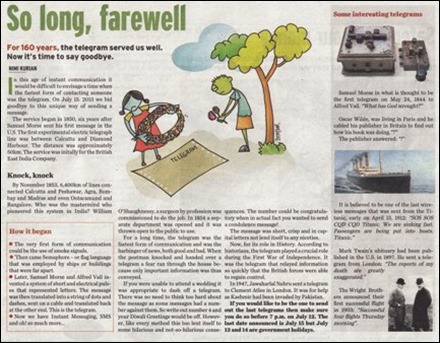
So long, farewell…

- NIMI KURIAN

image

In this age of instant communication it would be difficult to envisage a time when the fastest form of contacting someone was the telegram. On July 15. 2013 we bid goodbye to this unique way of sending a message.

The service began in 1850, six years after Samuel Morse sent his first message in the U.S. The first experimental electric telegraph line was between Calcutta and Diamond Harbour. The distance was approximately 50km. The service was initially for the British East India Company.

Knock, knock

By November 1853, 6,400km of lines connected Calcutta and Peshawar, Agra, Bombay and Madras and even Ootacamund and Bangalore. Who was the mastermind who pioneered this system in India? William O’Shaughnessy, a surgeon by profession was commissioned to do the job. In 1854 a separate department was opened and it was thrown open to the public to use.

For a long time, the telegram was the fastest form of communication and was the harbinger of news, both good and bad. When the postman knocked and handed over a telegram a fear ran through the house because only important information was thus conveyed.

If you were unable to attend a wedding it was appropriate to dash off a telegram. There was no need to think too hard about the message as some messages had a number against them. So write out number 4 and your Diwali Greetings would be off. However, like every method this too lent itself to some hilarious and not-so-hilarious consequences. The number could be congratulatory when in actual fact you wanted to send a condolence message!

The message was short, crisp and in capital letters not lend itself to any niceties.

Now, for its role in History. According to historians, the telegram played a crucial role during the First War of Independence. It was the telegram that relayed information so quickly that the British forces were able to regain control.

In 1947, Jawaharlal Nehru sent a telegram to Clement Atlee in London. It was for help as Kashmir had been invaded by Pakistan.

If you would like to be the one to send out the last telegrams then make sure you do so before 7 p.m. on July 12. The last date announced is July 15 but July 13 and 14 are government holidays.

Some interesting telegrams

Samuel Morse in what is thought to be the first telegram on May 24, 1844 to Alfred Vail. “What has God wrought?”

Oscar Wilde, was living in Paris and he cabled his publisher in Britain to find out how his book was doing. “?”

The publisher answered: “!”
image

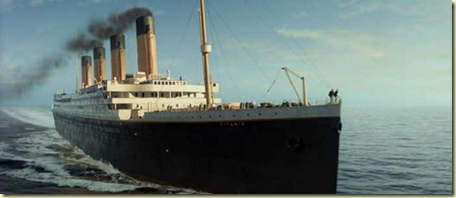
It is believed to be one of the last wireless messages that was sent from the Titanic, early on April 15, 1912: “SOS SOS CQD CQD Titanic. We are sinking fast. Passengers are being put into boats. Titanic.”

Mark Twain’s obituary had been published in the U.S. in 1897. He sent a telegram from London: “The reports of my death are greatly exaggerated.”

The Wright Brothers announced their first successful flight in 1903: “Successful four flights Thursday morning”.

How it began

The very first form of communication could be the use of smoke signals.

` Then came Semaphore – or flag language that was employed by ships or buildings that were far apart.

Later, Samuel Morse and Alfred Vail invented a system of short and electrical pulses that represented letters. The message was then translated into a string of dots and dashes, sent on a cable and translated back at the other end. This is the telegram.

Now we have Instant Messaging, SMS and oh! so much more…
: The Hindu - 9 July 2013

Untitled-7

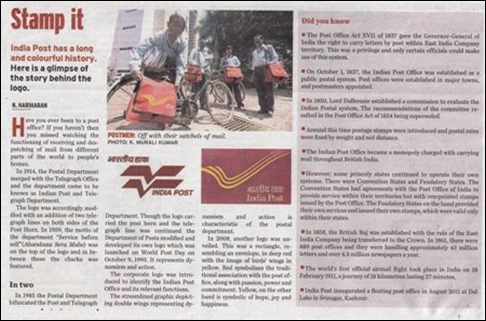
Stamp it - N. HARIHARAN

image

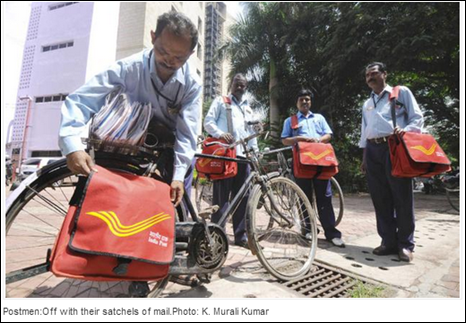
India Post has a long and colourful history. Here is a glimpse of the story behind the logo.

Have you ever been to a post office? If you haven’t then you missed watching the functioning of receiving and dispatching of mail from different parts of the world to people’s homes.

In 1914, the Postal Department merged with the Telegraph Office and the department came to be known as Indian Post and Telegraph Department.

image logo

The logo was accordingly modified with an addition of two telegraph lines on both sides of the Post Horn. In 1959, the motto of the department “Service before self”( Aharshana Seva Mahe) was on the top of the logo and in between these the charka was featured.

In two

In 1985 the Postal Department bifurcated the Post and Telegraph Department. Though the logo carried the post horn and the telegraph line was continued the Department of Posts modified and developed its own logo which was launched on World Post Day on October 9, 1993. It represents dynamism and action.

The corporate logo was introduced to identify the Indian Post Office and its relevant functions.

The streamlined graphic depicting double wings representing dynamism and action is characteristic of the postal department.

In 2008, another logo was unveiled. This was a rectangle, resembling an envelope, in deep red with the image of birds’ wings in yellow. Red symbolises the traditional association with the post office, along with passion, power and commitment. Yellow, on the other hand is symbolic of hope, joy and happiness.

Did you know

The Post Office Act XVII of 1837 gave the Governor-General of India the right to carry letters by post within East India Company territory. This was a privilege and only certain officials could make use of this system.On October 1, 1837, the Indian Post Office was established as a public postal system. Post offices were established in major towns, and postmasters appointed.In 1850, Lord Dalhousie established a commission to evaluate the Indian Postal system. The recommendations of the committee resulted in the Post Office Act of 1854 being superseded.Around this time postage stamps were introduced and postal rates were fixed by weight and not distance.

The Indian Post Office became a monopoly charged with carrying mail throughout British India.However, some princely states continued to operate their own systems. There were Convention States and Feudatory States. The Convention States had agreements with the Post Office of India to provide service within their territories but with overprinted stamps issued by the Post Office. The Feudatory States on the hand provided their own services and issued their own stamps, which were valid only within their states.In 1858, the British Raj was established with the rule of the East India Company being transferred to the Crown. In 1861, there were 889 post offices and they were handling approximately 43 million letters and over 4.5 million newspapers a year.The world's first official airmail flight took place in India on 18 February 1911, a journey of 18 kilometres lasting 27 minutes.India Post inaugurated a floating post office in August 2011 at Dal Lake in Srinagar, Kashmir.

The Hindu  - 9 July 2013

: Mahesh Parekh - Chennai

Chủ Nhật, 7 tháng 7, 2013


image image

Stamp Exhibition on  Tagore and  Mahatma Gandhi

PATNA: There's good news for the philatelists of the city. They will soon get a chance to have a glance at the rarest of the postage stamps of 'Kaviguru' and 'Mahatma Gandhi' from across the world. Rabindra Parishad, in collaboration with the department of posts, will organize an exhibition here on the postage stamps on Rabindra Nath Tagore and Mahatma Gandhi on July 9 and 10 to commemorate the 100th year of Kaviguru winning the Nobel Prize.


"For the first time, an organization is going to celebrate the 100th year of his winning Nobel Prize in the country," said Prodipto Mukherjee, convener of the exhibition. Around 400 rare stamps from 85 countries will be on display at the exhibition. Around 12 philatelists from across the world, including noted philatelist Sekhar Chakrabarty, will attend the exhibition. Chakrabarty is said to have the best collection of stamps on Tagore.


The exhibition will be inaugurated by Doordarshan's Deputy Director General K D Kalpit and CM Nitish Kumar may also visit the exhibition on any of the two days. When asked why stamps on Gandhi will be on exhibition, Prodipto Mukherjee said, "Mahatma and Kaviguru are two inseparable names. In fact, Kaviguru was the name given to Rabindra Nath Tagore by Gandhi and Mahatma was the name given to him by Tagore. So we decided to pay tributes to them together."


In fact, besides stamps, rare pictures of both Gandhi and Tagore too will be on display. However, stamp lovers in the city will have to remain content with only seeing the stamps as they will not be on sale. "Though the stamps are priceless and philatelists in the world are ready to pay any price for these stamps, we just aim to encourage the youth of India in the time of instant messaging and e-mailing, to take interest in hobbies like philately," said Mukherjee. The exhibition will remain open from 11 in the morning till 7 in the evening and entry will be free.

Read More….

Thứ Hai, 17 tháng 6, 2013


image

Nampost issued  two new souvenir sheets featuring children of Namibia. Namibia’s diverse cultural heritage is reflected in the bright faces of the children, yet the stamps also touch on key issues affecting children all over the world, alluding to the United Nations Convention on the Rights of the Child. The stamps are issued as two six-stamp souvenir sheets.

image 


Emilio Aragon “Miliki” on new Spanish stamp

image


Spanish Post issued a stamp to commemorate famous spanish Clown, Miliki.

The popular clown Miliki is one of the most beloved characters by generations of Spanish children, and on this occasion, he is depicted on the Popular Character stamp series by Correos which remembers all those who are part of Spanish historical and cultural heritage.

It was in 1973 when “Los payasos de la tele” (the TV clowns) made their first appearance on television with the welcome greeting: “How are you”. This expression marked the beginning of the show which continued with stories and songs and which entertained children for over a decade. The protagonists of the story were the Aragon brothers: Gaby, Fofa and Miliki, who were joined years later by their sons Fofito and Milikito.

Miliki and his brothers Fofa and Gaby began their artistic way by acting in the circus. In 1939 they joined the Circo Price and in 1945 immigrated to Cuba where they were very successful in television. For over 25 years they lived in America: Puerto Rico, Mexico, Venezuela, United States and Argentina were among the countries where they were cheered by the public.

On their return to Spain, they joined TVE (Spanish National Television) in 1973 with the premiere of “The Grand Circus of TV” which a year later was renamed “The clowns” and which was joined by Fofito and Milikito.

Besides being a comedian, Miliki played the flute and studied music and composition. After the separation of The Clowns he turned to music production and recorded several albums with his daughter Rita. He wrote books, published his memoirs and won several music awards. In 2008 and 2009 he recorded the albums: A misninos de 40 anos and A todosmisninos, in memory of those who for years were faithful to his friendliness and good spirits.

Club News

Maharashtra Times writes about Rainbow Stamp Club in Blog Up Column ...Thanks to Mr Ravindra Wamanacharya of Nashik who sent these scans to me and informed about the article !

maharashtra y maharashtra x

Customized Stamp sheet on Tagore from Royal Mail

Royal mail issued a customized sheet on Tagore.This sheet celebrates the 150th anniversary of Tagore.

image

Another sheet on Delhi 2010 Games. The details can be viewed at following links :

https://secure16.host-it.co.uk/bletchleycovers_co_uk/store/StockDetail.asp?id=355

https://secure16.host-it.co.uk/bletchleycovers_co_uk/store/StockDetail.asp?id=356

Radio Society of Great Britain Centenary 2013

A commemorative cover is being issued on 5th July to mark the Centenary of the Radio Society of Great Britain, the body that represents Britain’s radio amateurs. The cover being released through Bletchley Stamp Art features the Duke of Edinburgh against a montage of vintage and modern images. The stamp is Royal Mail’s “Station X” with a Bletchley Park Post Office cachet. This bears the early code number for Fenny Stratford post office and the undercover PO Box 111 address for Bletchley Park. The newly restored RSGB ‘hut’ at Bletchley Park provides the link to the cover design and stamp choice. The exhibit offers visitors a fascinating insight into the world of radio.

Only 250 covers are being issued  They can be viewed and ordered through the website at : bletchleycovers.com or by calling 01908 363489.

: Terry Mitchell - emailterry@ltmp.co.uk

nghe nhạc trực tuyếnNấu món chay | học nấu ăn DJ - Ảnh đẹp | xalotinnhanh