Thứ Tư, 26 tháng 3, 2014


Indian theme on foreign stamps

Noor

Date of Issue : 25 March 2014

Noor Inayat Khan,The woman of Indian origin worked for a secret organisation started by Winston Churchill

Britain’s Royal Mail has issued a postage stamp of Noor Inayat Khan, World War II heroine, who fought fascism and died in the Dachau concentration camp.

The stamp — part of a set of 10 stamps in the ‘Remarkable Lives’ series — honours Noor on her centenary year. Other honoured in the set include actor Sir Alec Guinness and poet Dylan Thomas.

“I am that Royal Mail has commemorated Noor with a stamp,” said Shrabani Basu, author of Spy Princess, The Life of Noor Inayat Khan, and the Chair of the Noor Inayat Khan Memorial Trust. “It will ensure that her sacrifice and bravery will not be forgotten.”

Ms Basu campaigned for a memorial for Noor which was unveiled in November 2012 by Princess Anne.

Noor Inayat Khan was born in Moscow in January 1914 to an Indian father, Hazrat Inayat Khan and an American mother, Ora Ray Baker. The couple had met in the Ramkrishna Mission ashram in America. Hazrat Inayat Khan was a Sufi preacher and musician, and travelled the world taking Sufism to the West.

Noor was brought up in Paris and the family moved to London when Paris was occupied by the Germans in 1940 during WW II. Noor joined the Women’s Auxiliary Air Force and was later recruited for the Special Operations Executive, a secret organisation started by Prime Minister Winston Churchill.

She was the first woman radio operator to be flown undercover to Paris. She worked from there for three months under the code name Madeleine. However she was betrayed, arrested and finally executed in the Dachau concentration camp in Germany.

Though she was tortured and interrogated, she revealed nothing, not even her real name. Her last word as they shot her was “Liberte”! She was only 30.

Noor was awarded the highest honour, the George Cross, by Britain. France awarded her theCroix de Guerre.

In 2006, President Pranab Mukherjee, then the Defence Minister, paid an official visit to Noor’s family house outside Paris and described her bravery and sacrifice as “inspirational”.

Read More..

‘India should issue stamp of WW II hero Noor Inayat’

London, March 25
As Britain's Royal Mail today issued a stamp of Indian-origin World War II heroine Noor Inayat Khan, campaigners called for India to bestow a similar honour on the famous spy in her centenary year.

The stamp - part of a series called 'Remarkable Lives' - honours Noor, a descendant of Tipu Sultan, along with nine others including actor Sir AlecGuinness and poet Dylan Thomas.

"It would be fitting if India too honoured Noor Inayat Khan in her centenary year with a stamp," said Shrabani Basu, chair of the Noor Inayat Khan Memorial Trust and author of "Spy Princess: The Life of Noor Inayat Khan".

"Though she was brought up in Paris, Noor identified strongly with her Indian roots," said Basu who led the campaign to build a memorial for Noor in London which was unveiled by Britain's Princess Anne in November 2012. Her book is now being made into a film.

"Noor believed firmly in Indian independence and frankly told her British officersthat after the war was over, she would back India's freedom struggle. Sadly she did not live to see India's independence," said Basu. Noor was born in Moscow in 1914 to an Indian father, Hazrat Inayat Khan and an American mother, Ora Ray Baker.

Her father was a Sufi preacher and musician and left his home town of Baroda to take Sufism to the west. He met Noor's mother at the Ramakrishna Mission while on a lecture tour in California.

Hazrat Inayat Khan was a descendant of Tipu Sultan, the famous 18th-century ruler of the kingdom of Mysore. Noor was brought up in Paris and the family moved to London just before Paris fell to the Germans in 1940 during the Second World War. She was the first woman radio operator to be flown undercover to Paris and worked from there for three months under the code name Madeleine. — PTI

The woman spy

  • The stamp - part of a series called 'Remarkable Lives' - honours Indian-origin World War II heroine Noor Inayat Khan, a descendant of Tipu Sultan, along with nine others

  • Noor joined the Women's Auxiliary Air Force in London and was later recruited for the Special Operations Executive, a secret organisation started by British PM Winston Churchill

  • She was the first woman radio operator to be flown undercover to Paris and worked from there for three months under the code name Madeleine

  • She was betrayed, arrested and executed in the infamous Dachau concentration camp in Nazi Germany

- Tribune 26 March 2014

Thứ Sáu, 21 tháng 2, 2014


Classic Locomotives

image

Date of Issue : 20 February 2014

Royal mail issued a miniature sheet featuring classic locomotives.

The delightful, bilingual Miniature Sheet features all four Classic Locomotives of Wales stamps, together with a dramatic photograph of the BR Class 5101 2-6-2T No. 4126 as it crosses the Crumlin Viaduct with a passenger train in 1963 in its border.

LMS No. 7720 First Class

Built in 1895 at the Crewe Works for the London and North Western Railway, the LMS “coal tank” is pictured leaving Britannia Bridge, pulling a Bangor-to-Holyhead local train in around 1930.

Hunslet No. 589 Blanche 78p

This stamp shows Blanche at the Pen Cob Halt on the Ffestiniog Railway in 1964. The locomotive was originally made for the Penrhyn Slate Quarry by the Leeds based Hunslet Engine Company. The narrow gauge Ffestiniog railway took slate to the harbour at Porthmadog.

W&LLR No. 822 88p

The Earl Photographed waiting for a car to be moved from the line on Welshpool’s Union Street in 1953, The Earl was constructed for the Welshpool and Llanfair Light Railway in 1902.

BR 5600 No. 5652 £1.28

The BR 5600 freight engine was designed by the Great Western Railway company to transport goods across its massive rail network. The stamp shows the loco pulling coal at Cwmbargoed in 1959.

British Flora

image

Date of Issue : 19 February 2014

Another set of stamps issued by Royal Mail on 19th February 2014 feature some varieties of British Flora. This is under the series Pictorial Post & Go Stamps by Royal Mail. The six Spring Blooms Post & Go Stamps are printed in a vertical strip and overprinted with First Class values. They are brought on a carrier complete with fascinating facts about each of these beautiful but in some cases declining species.

Primrose

Walk into a clearing in the woods and you could well be pleasantly surprised by a colony of primroses, for a sheltered spot between the trees is one of their favored habitats, as well as parks and churchyards. According to folklore, these lemon-yellow flowers with their heart-shaped petals – which flower from February to May – will grow red if watered with bullock’s blood or planted upside down on Good Friday.

Snowdrop

Haunting woods, meadows, parks and churchyards, these delicate lantern-shaped blooms encapsulate, for many, the beginning of spring. From the Amaryllidaceae family, they are in flower in February and March. A symbol of hope and purity, the snowdrop is traditionally dedicated to the Virgin Mary.

Lesser Celandine

Catch these bright yellow star-like flowers on a sunny spring day and you will be in for a treat, for they open wide in the sunshine. Spot them in woods and hedgerows and on road verges and the banks of streams from March to May. “Local” names for the celandine include “goldy knob”, “filding cup” and “golden guinea”.

Common Dog Violet

From April to June, these rich purple flowers bloom across Britain’s woods, downlands and grass heaths. From the Violaceae family, dog violets are widespread throughout the British Isles.

Wild Daffodil

The iconic bright yellow flower that famously inspired William Wordsworth blooms from February to April, and is seen in coppice and open woodland. Its Latin name, Narcissus pseudonarcissus, is said to have come from the Greek mythological figure Narcissus, who fell in love with his own reflection in a pool of water. The daffodil’s trumpet shaped center is seen as the head of Narcissus bending down while he admires his face in the water. Daffodils are traditionally meant to first flower on St David’s Day – 1 March.

Blackthorn

Forming hedgerows and scrub, the white flowers of this very spiny shrub are in bloom from March to May. Come the autumn, the blackthorn produces sloes – those plump, purple berries that are used, of course, to make sloe gin.

Thứ Tư, 20 tháng 11, 2013


image image

Date of Issue : 5 November 2013

Here are new stamps  issued by Royal Mail for this year’s Christmas. Royal Mail has been issuing Christmas Stamps every year since 1966, and  they are now a much-loved part of the festive season. Royal Mail has chosen  a Madonna and Child theme for Christmas 2013. These have been created using details taken from Madonna and Child paintings down the ages and across many cultures, including the newly commissioned Neo-Coptic style stamp, painted by Fadi Mikhail. The other two stamps shown above feature paintings by children selected from a Christmas stamp design competition of children between 4 –11.

image

image

Date of Issue : 5 November 2013

image


The Miniature Sheet features all seven Christmas Stamps, which include Large First and Second Class values, all set on a glorious golden border that echoes the iconic backgrounds typical of Madonna and Child depictions from down the ages and across many cultures.

Second Class and Second Class Large Stamp
In Antoniazzo Romano’s Virgin and Child with the young St John the Baptist (c.1460–80), in the Early Renaissance style, Mary holds Jesus on her left arm and points towards him with her right, indicating that he is the way to salvation.


First Class and First Class Large Stamp
In Madonna and Child (c.1520), painted in the High Renaissance style, Francesco Granacci depicts the Virgin in her traditional garments of red and blue, earthly and divine, while the bird in Christ’s hand alludes to the coming Passion.


88p Stamp
Jacques-Louis David’s St Roch Praying to the Virgin for an End to the Plague (1780), which is painted in the Neoclassical style, is a deeply Catholic painting, depicting the Virgin Mary in her role as protector and intercessor.


£1.28 Stamp
In La Vierge au Lys (1899), painted in the French Academic style by William- Adolphe Bouguereau, the Virgin and Child are enthroned, with Jesus held close by his mother, his outstretched arms suggestive of the crucifixion to come.


£1.88 Stamp
In Theotokos, Mother of God by Fadi Mikhail, which is painted in the Neo-Coptic style, Christ’s white tunic indicates his divinity, while the Virgin Mary’s blue mantle likens her to the sky, as in the icon of The Flight into Egypt.

Thứ Sáu, 11 tháng 10, 2013


image

Date of Issue : 10 October 2013

Royal Mail  launched its Dinosaur Special Stamps issue to mark over 200 years of dinosaur fossil discoveries in what was the UK.

Dinosaurs have often been associated with North America and the exploration of the Wild West that began in the 1870s, but the earliest discoveries of dinosaurs and their contemporary marine and flying reptiles happened in England during the early 1800s.

image

image 

The dinosaurs in this 10-stamp set have strong connections with Dorset and pioneering fossil hunter Mary Anning, the Isle of Wight, Oxford shire, Surrey and Sussex. The set features illustrations of Polacanthus; Ichthyosaurus; Iguanodon; Ornithocheirus; Baryonyx; Dimorphodon; Hypsilophodon; Cetiosaurus; Megalosaurus and Plesiosaurus.


image

The featured reptiles are:

  • Polacanthus: the heavily armoured Polacanthus was protected from predators by a host of spikes and studs.
  • Ichthyosaurus: adapted to life in the sea, the Ichthyosaurus breathed air and gave birth to live young in the water.
  • Iguanodon: the herbivorous Iguanodon was able to walk on all fours, but would run using only its hind legs.
  • Ornithocheirus: this relative lightweight flew mainly by soaring and gliding, catching fish by skimming the sea.
  • Baryonyx: with a name meaning “heavy claw”, the thumb claw alone of the Baryonyx was more than 40cm long.
  • Dimorphodon: with its one meter wingspan and two types of teeth, the Dimorphodon preyed upon fish.
  • Hypsilophodon: the long shins of the Hypsilophodon suggest that a speedy escape was its main means of defence.
  • Cetiosaurus: the Cetiosaurus was a herbivore thought to weigh as much as 20,000kg, the same as 20 cars.
  • Megalosaurus: the fearsome Megalosaurus grew up to nine meters in length, and preyed upon other Dinosaurs.
  • Plesiosaurus: with its vast paddles, the Plesiosaurus hunted fish and other marine prey at an estimated 8kph.


Chủ Nhật, 28 tháng 7, 2013


image

Date of Issue : 8 August 2013

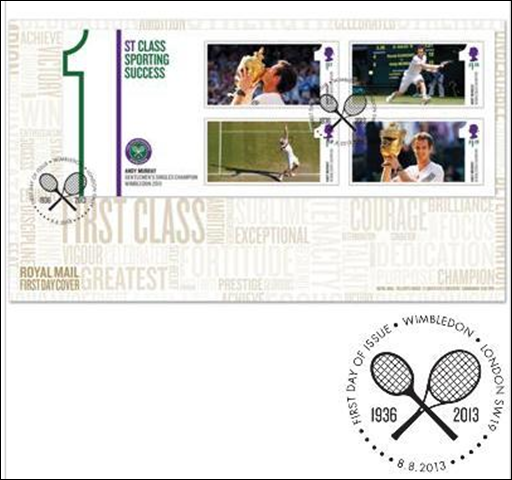
This new issue from Royal Mail will mark the English victory Andy Murray in tennis at Wimbledon with a four stamps issued on August 8, which shows the tennis player to win the cup, and he throws it at various stages. This victory against Novak Djokovic is the first men's singles title for a British tennis player since Fred Perry in 1936.

image

The Miniature Sheet comprises two First Class and two £1.28 stamps featuring dramatic images from this classic final, including the moment when Murray kissed the famous trophy in celebration.


It also includes the official device of the Wimbledon Championships in its border, and represents the first in a new series of Special Stamp issues to honour most successful sportsmen and women.

The stamp designs :

First Class Stamp (Top left)
Andy Murray kisses the Wimbledon Gentlemen’s Singles trophy in triumph. First presented by the All England Club in 1887, Murray is the first British player to hold this coveted trophy since Fred Perry lifted it in 1936, an incredible 77 years ago.


£1.28 Stamp (Top right)
Murray steps up to return the ball with the absolute concentration and determination that characterised this famous win. In the entire match he made just 21 unforced errors, compared to the 40 that were made by world number one Djokovic.


First Class Stamp (Bottom left)
Andy Murray serves during the final set of his Gentlemen’s Singles final victory over Novak Djokovic. His consistent serving was crucial to his victory, as he won 72% of the points from his massive first service, compared to just 59% for Djokovic.


£1.28 Stamp (Bottom right)
The winner of the 2013 Wimbledon Gentlemen’s Singles holds the famous trophy aloft, to the delight of an entire nation. It was all a far cry from the heartbreak of the 2012 final, and as Murray himself said: “Hopefully we can do it all again next year.”

Thứ Hai, 1 tháng 7, 2013


image

110 postboxes were painted gold in 2012 to celebrate the achievements of Olympians and Paralympians

Hi !

I am sharing here a news about an Oxford Postman’s tour of golden post boxes published by BBC . The tour by this Postman is for a noble cause…. I am also sharing here a discussion on stamp errors published in Sandafyre. 

A postman from Oxford is visiting all of the gold postboxes on the UK mainland that celebrate Britain's Olympic and Paralympic champions. Gary White, 29, began his 3,200-mile tour of 104 boxes at Kirkby-in-Ashfield in Nottinghamshire.

He aims to complete his journey on 25 July at the Olympic Park, east London. At each location, the nomadic postman said he would photograph the postbox and send a postcard to himself to document his journey.

Andy Murray

He plans to use the corresponding commemorative Olympic stamps produced by Royal Mail during the 2012 Games. At Dunblane, the stamp will feature Andy Murray, recognised for his gold in the men's singles tennis.

Gary White

Postman's holiday: Gary White hopes to complete his tour on 25 July

The postman's tour is raising money for the Motor Neurone Disease (MND) Association in memory of his stamp-collecting aunt, Christine Goodall, who lived in the US.

Mr White said: "I have chosen the MND Association as my charity because my aunt sadly died last year, after battling with this disease for five years - she was only 56 years old.

"I had bought all of the special gold medal stamps with the intention of using them to send her a postcard... sadly, time passed too quickly for me to do this.

"I thought that this event would be a good way to raise money and awareness for this disease, to continue the helpful, happy and charitable mood that was present during London 2012, and to use up some of those stamps for a good cause."

He believes he is the first postman to undertake such a tour.

Courtesy : BBC News

Discussion

Why do Stamp collectors like errors ?

Sometimes discovering philatelic errors is easy, particularly when examples have been identified and are accurately described. This is not always the case and many hours can be spent searching philatelic material to find that illusive mistake. Such items are keenly sought by collectors who need to satisfy a unique personal desire.

why do we find printers mistakes so alluring? It was around the turn of the last Century that the so-called “French Method” of collecting became fashionable, no longer did the best collections simply aspire to total completion but the proofs, drawings, subtle colour changes, plate alterations & damage, and all the other fascinating stuff that makes our hobby so interesting became de rigueur in the highest collecting circles, but errors were already popular long before then...

THE RAREST ERROR is widely considered to be the world second most valuable stamp. The Swedish 1855 3 skilling-banco printed in yellow instead of the correct green colour. It was discovered in 1885 by a Stockholm stamp dealer who bought the stamp from an unsuspecting schoolboy. The stamp has been shrouded in controversy but it has been a famous error for over 100 years and it is generally accepted that a single 3sk cliché had found its way into a printing of the 8sk orange- yellow. Back in those early days of stamp production anything was possible!

DIFFERENT TYPES OF ERRORS exist, mistakes made by the printer are the most dramatic, perhaps the most well- known of these is the American so-called “INVERTED JENNY” stamp. The United States issued a set of Air Post stamps in 1918, the top value was a splendid 24c depicting a Curtiss Jenny biplane in blue within a red frame. The day after issue a stamp collector, Mr William T. Robey visited his local post office to purchase a sheet each of these first airmail stamps. He didn’t like the centering of the sheets available so at the suggestion of the clerk he returned later that day and was amazed to find a complete sheet of 100 24c values with the plane upside- down!

This discovery, perhaps more than any other in philately convinced collectors to carefully check newly issued stamps for printing errors! A block of four from this sheet is currently the most valuable philatelic item.

DESIGN ERRORS CAN BE FUN (AND DANGEROUS) as they are often mass- produced the mistake can be available to thousands of collectors, a typical example would be the Monaco 1947 Air Post stamps depicting President Roosevelt inspecting his stamp collection – look closely and you will see he has been given SIX fingers by the engraver! Sometimes design errors can be a lot more serious, for example the Peoples Republic of China issued, during the height of the Cultural Revolution an 8f stamp known as “the Whole Country is Red” depicting workers with a map of China coloured red – however Taiwan was left in white, a terrible mistake (albeit accurate as the Communists never controlled the island). The stamp was withdrawn after 2 days and is a renowned rarity. There is no record of what befell the hapless designer...

During the 1960s many other countries saw exciting (and less dangerous!) new concepts in stamp production with modern multi coloured artistic designs. Printing errors occurred and many collectors specialise in locating examples from this period including missing colours & and incorrect values (to name just a couple). The choice is virtually endless. Perhaps one of the most infamous errors from that period would be the Falkland Island 1964 6d stamp depicting HMS “Glasgow” instead of HMS “Kent”. Examples of the error are extremely rare with only seventeen known to exist. The committed collector will still seek to find number eighteen!

Collectors follow their desires. Psychologists have identified a need in many of us to acquire and collect. Philatelic errors probably fulfill those who may possess that particular gene! This could be just one of the many reasons why stamp collectors like errors but there must be many other reasons. Compulsive collectors cannot bear distractions, just as my friend focused on the details of the Australian discovery, they are immersed in their subject and driven by the need to accumulate and acquire. Philatelic errors offer just such an opportunity. Human nature relishes and thrives on the search, the hunt, the hope of finding something unique, the use of the “sharp eye” and discovering the unexpected. This alone makes the subject more exciting, dramatic and also challenges the dull image that is often associated with stamp collecting !

Read More….

Thứ Sáu, 21 tháng 6, 2013


image

Date of Issue : 18 June 2013

Royal Mail issued a new set of stamps on classic locomotives on 18th June. Classic Locomotives of Northern Ireland is the third in Royal Mail’s series to commemorate these unsung workhorses of the railway network. The set of four stamps and a miniature sheet feature following locomotives : Royal Mail has also issued for  stamp cards for each stamp.

1st Class – UTA W Class No. 103
UTA Class W No.103 ‘Thomas Somerset’ with a Belfast-bound up express between the two tunnels at Downhill, west of Castlerock c1950

78p – UTA SG3 Class No. 35
The SG3 Class locomotive shunts wagons at Portadown in 1963..

88p – Peckett No. 2
Peckett No.2 reverses wagons into the British Aluminum works at Larne in 1937.

£1.28 – CDRJC Class 5 No. 4
The Class 5 locomotive Meenglas shunts a carriage at Strabane in 1959.

The Miniature Sheet features all four Classic Locomotives of Northern Ireland stamps, together with a fabulous photograph of the UTA Class Z No. 27 Lough Erne crossing Larne Lough in 1968 in its border.

Classic Locomotives of Northern Ireland Stamp Cards

image

Each of these glorious stamps, together with the Miniature Sheet itself, has been reproduced at postcard size.

New stamps from Canada

image

Date of Issue : 21 June 2013

Canada Post unveils two stamps honouring Canadian heroes Laura Secord and Charles de Salaberry; the second in a series commemorating the War of 1812.

image

Niagara Falls MP Rob Nicholson and Canada Post representative Tom Creech at a Laura Secord stamp and coin release in Queenston on Friday.

Secord braved a 30-kilometre walk through the wilderness to warn a British outpost of an impending American attack.   In June 1813, a group of American officers billeted themselves at the home of Laura Secord in Queenston.  She overheard the officers discussing plans to attack a British outpost.  Secord managed to secretly slip away to warn the British.  She found the local British commander, Lieutenant James Fitzgibbon, who used the information to position his men and First Nations warriors to ambush the enemy and capture more than 400 American soldiers.

In the fall of 1813, as commander of a group of fighters in Lower Canada, Lieutenant-Colonel de Salaberry’s strategy enabled his outnumbered Canadian force to fight off an American invasion aimed at capturing Montréal.  He anticipated the invaders would cross the Châteauguay River, 50-km southwest of Montréal.  De Salaberry used the swampland and trees to his advantage, ordering his men to build barricades of felled trees and then spread his troops across the area, giving the impression of a large, hidden Canadian force.  After four hours of fighting, the Americans retreated and Montréal was saved.

New special Covers

image

A special cover was released by Andhra Pradesh Postal Circle in honour of former President of India, Dr. Neelam Sanjeeva Reddy on 19th May 2013 to mark his 100th birth anniversary celebrations.

First All Women Post Offce of Maharashtra

image

12 April 2013 : Mumbai

: Prakash Bubkiya

Chủ Nhật, 2 tháng 6, 2013


image

Date of Issue : 30th May 2013

Her Majesty the Queen – Six Decades of Royal Portraits stamps from Royal Mail

image image

Portrait Cards & Framed Royal Portrait Stamps

To mark the 60th anniversary of the Queen’s Coronation, Royal Mail has created an extraordinary collection featuring some of the finest portraits of Her Majesty Queen Elizabeth II. The portraits are the following (in chronological order):

1953 Terence Cuneo – 2nd Class; it was the Queen’s representatives, the Lord- Lieutenants of England, Scotland, Wales and Northern Ireland, who commissioned Cuneo to paint the Coronation. The artist attended all eight rehearsals for the event then began painting in the early morning of the Coronation, sketching for eight hours straight. The painting featured on the stamp is a preparatory oil sketch depicting the Queen alone, executed with great liveliness of brushwork and intensity of colour, seen especially in the abstract haze of light surrounding the figure.

1955 Pietro Annigoni – 88p; this celebrated portrait was commissioned in 1954 by the Worshipful Company of Fishmongers for their magnificent hall overlooking the Thames.

Pietro commented how in awe of the Queen he was, until she began chatting to him in French. She told him that as a child she liked to watch the world go by from the windows of Buckingham Palace. It was at this moment Pietro realised what his portrait should convey: “the Queen who, while dear to the hearts of millions whom she loved, was herself alone and far off.”

1992 Richard Stone – £1.88; in 1989, Richard Stone’s home town of Colchester celebrated its 800th anniversary of its Royal Charter; a portrait was commissioned to mark this occasion then later unveiled at the National Portrait Gallery. The artist’s style is intended to match the grandeur and dignity of the golden age of British portraiture. The profile view adds an element of gravity and introspection. After seeing the finished work, the Queen remarked somewhat prophetically, “it will make a good stamp”.

1999 Andrew Festing – 78p; commissioned by the Royal Hospital Chelsea, this portrait is displayed in the entrance hall of its museum. The Queen is shown at Chelsea Hospital, on the steps leading to the Council Chamber. She wears the regalia for the State Opening of Parliament – the Parliamentary Robe of State and the Diamond Diadem. Her traditional costume conveys the continuity in British life of which the monarchy is the most powerful expression.

2000 Sergei Pavlenko – £1.28; commissioned by the Worshipful Company of Drapers to celebrate the 50th anniversary of the Queen becoming a Freeman of the Company, this painting hangs in the Court Dining Room at Drapers’ Hall. Unveiled in November 2000, the portrait shows the Queen in Garter robes with one unusual addition – the Drapers’ brooch, presented to Her Majesty in 1947. Pavlenko’s image conveys the Queen as the nation’s most exalted and famous hostess, welcoming hundreds of people every year to Buckingham Palace.

2013 – 1st Class; this portrait was commissioned by Royal Mail especially for this collection and shows the Queen in Garter robes. The artist demonstrates mastery of paint, with the Queen’s head carefully described yet with remarkable animation in the brushstroke and expression. The finished piece shows the Queen wearing the regalia of one of her offices with an easy and cheerful assurance. The portrait expresses Her Majesty’s joy and quiet

: Royal Mail

Yahsat - UAE's Communication Satellite

image

Emirates Post issued a commemorative stamp on communication sattelite “ Yahsat” in May 2013 .

Yahsat is a satellite communications company wholly owned subsidiary of Mubadala Development Company, the Abu Dhabi Government's strategic investment company. The company offers voice, data, video and internet services for broadcast, Internet and VSAT users for both private and government organisations.

Incorporated in January 2008 the company had an aim of developing, operating and using multi-purpose (Government and commercial) communications satellite systems for the Middle East, Africa, Europe and South-West Asia regions. Yahsat products includes Satellite Broadband Internet, Satellite Broadcast, Secure Satellite connectivity.

: Kenneth Sequeira – Dubai : email : kenneth.sequeira@hotmail.com

nghe nhạc trực tuyếnNấu món chay | học nấu ăn DJ - Ảnh đẹp | xalotinnhanh